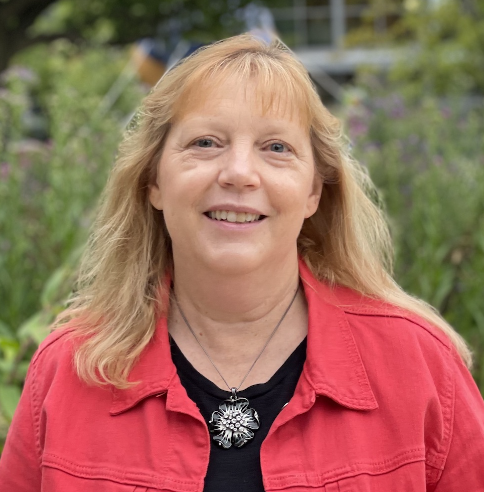
Did you always know that you wanted to study biology and environmental studies?
: Yeah, in fact yes. I was always interested in biology. In undergrad I majored in biology and my minor was in environmental science. In graduate school for my masters degree, I have a bio-ecology major and that is where I did the fish study, where I was looking for genetically pure populations for the state of Utah to reintroduce the native Colorado River Cutthroat trout. (We talked about that in AP Bio when we talked about hybrid zones, remember.) I also worked for the US Fish and Wildlife Service as part of their breeding bird survey and I had a whole section of folks that worked with me in these mountains between Utah and Wyoming.
So when you chose to study fish in graduate school was that influenced by your mentor?
: Well, my study was more influenced by the type of question that I wanted to ask at the time. Because the DNA technology was not as good when I was in grad school, I had wanted to work on birds but I studied fish because, fish in a stream are genetically very different from one stream to another whereas birds are very homogenous over a large area. So fish were a better population to study.
So did you have a mentor in or throughout college and in what ways did they guide you?
: Yeah I did have a mentor and, as an undergrad at the school I went to, we had to do a research project. So I studied animal behavior and mating behaviors in this type of bird in western NY. And my mentor for that project was also, I would say, he was also my mentor for, kind of like my advisor in college. My mentor, yeah he helped me, he was actually friends with my advisor I had in graduate school so he connected me with my grad school advisor. We met at a bird meeting where I was presenting the undergraduate research we did.
And so what would you recommend, what would be some advice you would give to young scientists interested in your field specifically?
: Well in my field, just look out there for the different opportunities. There are so many different opportunities and be open minded about what types of schools and programs you would choose for both undergrad and grad school. I was able to, for grad school I did work on fish as my research project, but the work I did with birds on the breeding bird survey paid for my grad school. So you could do what is called a graduate-assistantship. I did both- I did graduate assistantship which paid for my summer, and then during the year I was a teaching assistant for the biology department. As a teaching assistant was where I learned I really like to teach in addition to research, by exploring different options it helps you find your niche better.
So when did you go into academia? Was it right after grad school or later on?
:Right after grad school I actually taught in Weber State University in Ogden, Utah for a year and then I taught at Corning community college and then I ended up teaching at Pre K -12 schools so that was kind of my order. And actually right now I am working on my doctorate on representation in stem but focusing on representation in computer science.
And so did you have someone who influenced you overall from your high school career until now that has guided you through this?
: I grew up in upstate NY where we lived on a dirt road so I was very exposed to nature and things like that, so I think my parents started me on the biology path. My dad is also an engineer, and that also influenced my interests and even career path. One of my favorite teachers in high school was my biology teacher and my homeroom teacher was another biology teacher, but he was, I would say , influential too.. At each school I went to, I made sure to make connections with a like minded mentor type of person, or at least one, but a lot of times more than one. And in grad school I had I would say a geneticist mentor, fisheries mentor and a bird mentor. In undergrad I had an animal behavior and a developmental biology professor who I would also consider a mentor. But again, I really have always loved biology.
Do you prefer academia over research?
: Yea I prefer teaching over research. Research is fun and doing a little bit of research is great but I like the interaction of the students versus the interactions in the lab. I worked in labs and it can get narrow minded and laser focused. I tend to be interested in a range of topics and not just specialize.
And what is one thing that you really liked about what you did or what is one fun fact you like to tell people about what you studied?
: One fun fact, I always thought it was so cool I got paid to walk in the woods with binoculars and look for birds in graduate school and a couple environmental consulting jobs. Like it was one of those things that now I do that for fun, but when I was in grad school that was how I made money. So, um, it is great when you can have a job that is something you would probably just do for nothing.
Editorial Note: On behalf of myself, the other writers and editors, we thank Ms. Bischoff for this amazing interview and volunteering as advisor for the Science News!!
 Science News
Leave a comment