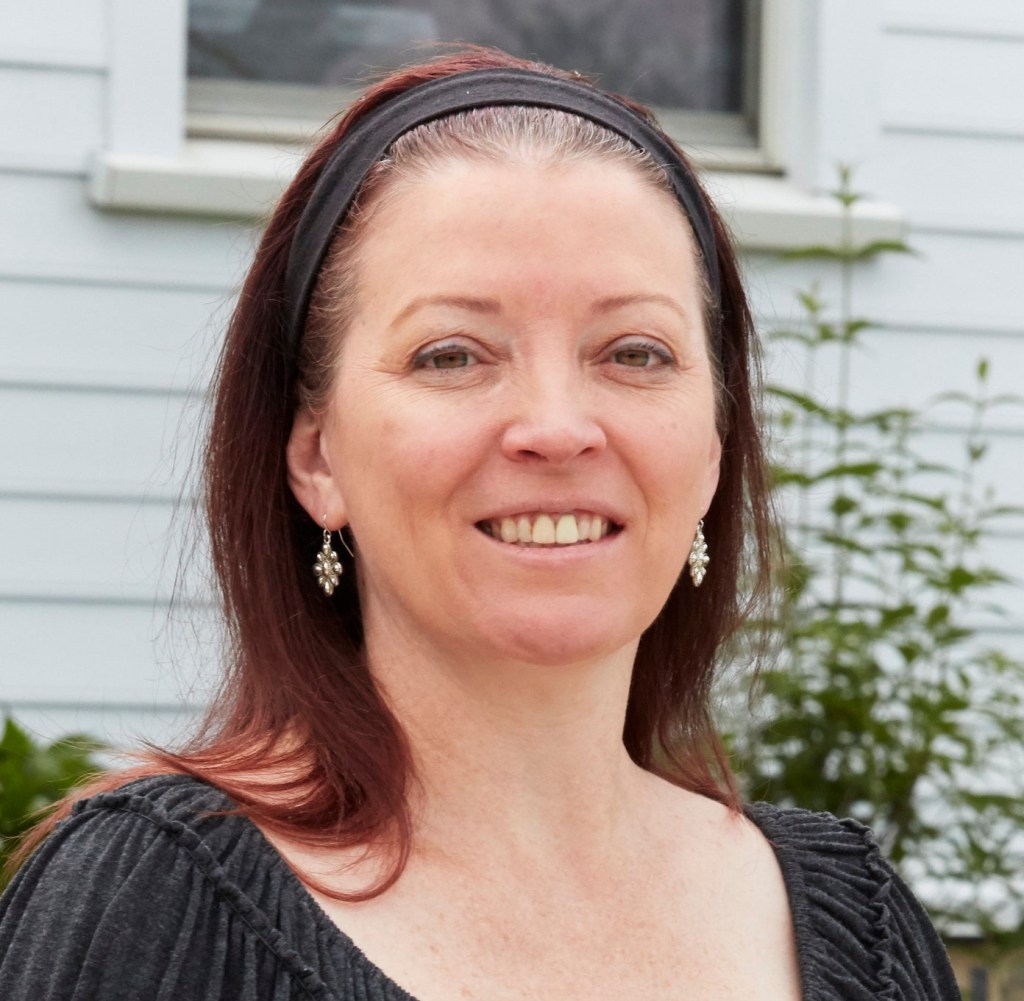
I recently had the chance to interview Dr. Krasovec and learn more about her background and physics journey. I hope that others reading this will be inspired by her story.
What made you interested in physics?
I had the most amazing high school physics teacher. His name was Mr. Brown. He was a big guy who always wore rock and roll t-shirts and had a big red beard. And he spent every summer riding his Harley up and down the California coast. And he was just very entertaining and very cool.
So he made you interested in physics?
Yeah. I didn’t know what I wanted to major in, so I went to the orientation at college and thought, you know what? Until I figure out what I want to do, I’m just going to go with the arts and sciences and take physics classes. And I never changed. And from there, it’s been a love of physics ever since.
Are there any specific interests in physics that you have?
Well, I started in astrophysics because space is just super cool. Right? And I did an internship in California, which was super cool. And I did astrophysics things and wrote code. Then, I changed to geophysics because I wanted to do something more practical and applicable to the real world, which, as it turns out, all fields of science are not applicable but also applicable depending on how you approach them. So, I don’t know; I was a little naive about that. But studying the Earth is also very cool.
Did you do any specific projects in geophysics?
Yes, I did a project that used seismic waves to map the Earth. So, a lot of computer programming and the head of my committee would use seismic waves to map subduction. So you’d see the shape of the plates being subducted under Japan and things like that. But a lot of it was imaging oil reservoirs. So, I was largely funded by and offered jobs with oil companies.
What has your path been like since high school in the physics field?
Well, I guess getting an undergraduate physics degree isn’t generally going to get you a job in physics. So clearly the thing to do for me was get a PhD. And so I did. But then I didn’t really want to live in Texas or do oil. So I worked at a small geophysical company for a few years, and actually, that was some really interesting stuff, too. But then I had a friend who taught at Andover. As it turns out, my friend was a chemistry Ph.D. and loved to play soccer and loved to do pottery. I have a lot of hobbies, and I thought, boy, teaching would be cool because then I could do physics, but I could also exercise my hobbies and get involved in many aspects of student life.
How would you describe the process of getting an undergraduate degree in physics or getting a Ph.D. in physics?
That’s not a small question. I mean, you have to love doing it, right? I just enjoyed the material, and I enjoy solving problems. And the thesis certainly was hard because at least where I went, there was no one saying, here’s the problem you should solve, and here’s how you should do it. This is why I think YPT is so valuable. It was like you’re just given a few years of classes, and then you’re thrown to the wolves, and they’re like, here’s a project you could get involved in. And for me, getting the Ph.D. thesis wasn’t solving a problem. It was figuring out what the problem was. And I can remember distinctly that I had been working on this data set for two years, and I had no idea what to do with it. And it was a very flawed data set. But one night in the depths of February, I figured out, oh, here’s a thing that’s wrong with it and here’s why, and here’s an algorithm I can do to correct the problem. And I didn’t know the algorithm yet, but I understood, oh, here’s a problem. And there’s a path to finding a solution. And three months later, it was done.
What specifically was your PhD thesis about?
So there’s a way of imaging the underground where you put sources down in a borehole. The sound waves have less distance to travel, and you can get a higher-frequency image of the reservoir. And the problem is, you’re only looking at the reservoir from one angle because your source is in a limited space, as opposed to these big surveys where they put sources and receivers over tens of miles on the surface, and you get lots of angles. And there were some particular failures in the data set that I had. So, it was geometrically very limited. And I worked out some geometrical relationships that allowed me to remove artifacts. I looked at my thesis at some point recently, and I don’t remember half of the theory and my theory chapter, but you know, I remember what it means, but I don’t remember how I derived it. It was really complicated.
It’s really satisfying to know you’ve figured out something no one else has.
So, would you say this method was completely innovative?
I mean, it was based on other things, but no one had done specifically what I did. Really, we’re always standing on the shoulders of someone else, right? Very few people come up with something that’s completely novel and completely unique. And even Newton, right, built his laws based on other people’s observations.
What would you say to students who might be having a difficult time in physics? What would you do, or what would you say to encourage them or help them out?
Mostly, if I see students struggling in physics, there’s one of two causes. One, maybe they’re not interested in it, which is valid; if you don’t like a subject, it’s hard to learn it. Right? There are subjects I haven’t liked, and I was terrible at learning. So, if you can find some way to think of it as a puzzle that’s enjoyable, that helps. The other reason students struggle is that they don’t trust themselves enough; they think it’s all about doing what someone else has told them is the right thing to do instead of finding their own way to do it. Which is a natural part of education, right? When you’re in elementary school, of course, you’re doing what other people tell you because you don’t know anything. You need to get this information. And at some point, you have to just trust yourself to run on your own. And that can be terrifying for a student who’s never done it.
Is there anything unique about the problem-solving process in physics specifically, or just the problem-solving process in general?
It’s just very logical. If you know the patterns to look for, it can be very efficient.
And what about students who are interested in pursuing physics in the future? Do you have any inspirational advice for them?
Pay attention to what’s going on out there in the world! There are so many applications that are unique. And it’s not all the physics that you learn in high school, right? There’s physics-based stuff in computing, biology, chemistry, and data. Just data and computing can do so much, like physics-based animations. There are just so many really cool things you can do out there that you don’t want to stay in your tower; you want to read about what other people are doing. Right? Because they’re doing some really cool stuff. You want to branch out.
Computer science has become, at least recently, a much more common thing in science fields. In the past, was that always the case? And how would you say physics has adapted to integrate computer coding and science?
I think it’s just become more common. And computers are just so powerful now. When I was in school, we had these massive multi-parallel computer systems that took up a whole room, were so cutting edge, and cost zillions of dollars. And now a basic PC can do that. What’s funnier is that the people 20 to 30 years before me didn’t have computers. So, to do the data processing for these kinds of things, they had all these amazing slide rules. What people did without computers was quite ingenious.
The slide rule was a hand-operated mechanical calculator.
They’re kind of brilliant. You can do anything with them. You can get long division, exponentials, and logs.
That actually looks really complicated.
Yeah, computers are just so powerful now. They can do crazy things very easily and quickly.
Before you were interested in physics, or even after you became interested in physics, are there any other things that you find really interesting?
Yeah, I mean, I’ve had many hobbies. So, in undergrad, I majored in physics and math, and I minored in dance, which I guess other advice I would give people is don’t put any rules on it. I don’t know if you’re supposed to run back and forth between ballet class, math class, modern class, and physics, but do that if you want. Who cares? In grad school, I was really into making pottery, and I remember I gave an interview to someone in grad school, and they were like, tell me about how geophysics relates to pottery. I’m like, no, it doesn’t. I mean, I do pottery, and it’s fun. And then I go write code, and it’s fun, and it doesn’t have to be some universal truth or anything. You do things that make you happy.
But there are professors out there who will say, how dare you join that theater production when you should be working on your thesis? And yeah, you want to get your thesis done, but you have to have other things that are fun and that you enjoy. And if there’s anyone telling you you can’t do the things you really love, they’re wrong.
Just out of curiosity, how long have you been doing YPT for?
I started here in 2008, and I attended the 2009 tournament just to see it. And then the other physics teacher that was here left in 2012. And after that, I took over the team. So I kind of just watched and helped a little bit. But the 2013 tournament was, I think, the first one. Is that right? No, I took over before he left, so maybe he did 2009, and then 2010 was canceled because of snow. So maybe, yeah, I think I was involved in 2011 and 2012. Then he left after that, and I took over. And I’ve had various teachers help with it since then.
Editor’s Notes:
(1) On behalf of myself and the other writers and editors, we thank Dr. Krasovec for this amazing interview!!
(2) Dr. Krasovec currently teaches AP Physics 1 and AP Physics C – MEM and is a coach for the Rye Country Day School Young Physicists Tournament team.
(3) YPT refers to the US Invitational Young Physicists Tournament (USIYPT), hosted by the US Association for Young Physicists Tournaments (USAYPT). Rye Country Day School is a proud three-time champion of USIYPT, with victories in 2012, 2017, and 2024.
(4) The text in bold was said by the interviewer (Jaymin Ding), and regular text was said by the interviewee (Dr. Krasovec).
 Science News
Leave a comment