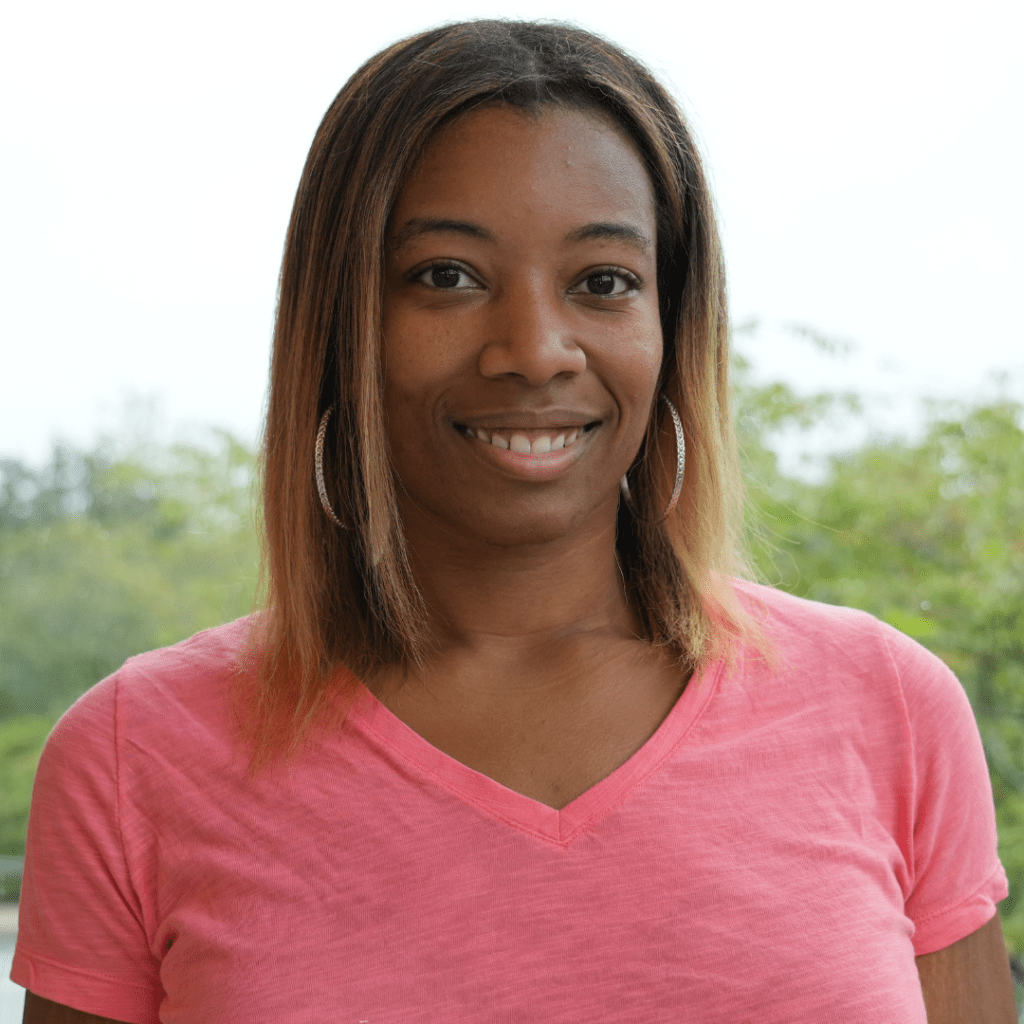
I recently had the chance to interview Ms. Farrell and learn more about her background and journey in chemistry. I hope that others reading this will also be inspired by her story.
What made you interested in science?
So, I’ve always loved science, even though I technically didn’t know what it was when I was a little kid. But my first entry into science was with my fourth-grade teacher, Ms. Bach. She gave us a little small envelope, and she said, “I want all of you to go home. I want you to mix whatever is in this envelope of water. And I want you to pour it into your backyard or your garden and write down your observations.” So, I came up with all these ideas or thoughts of what would happen. And much to my disgusted surprise, a bunch of worms came out of the ground. And so, I was so excited to report it back to my teacher, and again, this was before the internet. But the next day, she wanted us to come up with reasons for why that happened. It was interesting to listen to all of my classmates’ crazy ideas as to why what happened. And it was at that moment, I was like, “Oh, I like thinking like this. This is pretty cool!”
Then, in my 10th-grade year of chemistry, that was my second moment where I was like, wow, this is something I really love doing and studying and learning more about. My chemistry teacher always really pushed us to think of multiple ways to solve a problem, and she always encouraged us to use all of the information that was available to us to solve a problem. And it was that year I thought about majoring in chemistry. So, I majored in chemistry in college. It was definitely not easy. It’s one of those experiences where you think you know something but you really only know the basics of it, a ground-level understanding of it.
And then your expectations from your professors are also different. So, if you met three times a week, then there’s an expectation that you should be able to cover all of, let’s say, atomic structure within that week without any real help from the professor. So, it took some time for me to understand the structures of college and the idea of utilizing office hours with my professor and managing expectations. So, I came to the understanding that very few people are constantly going to get 90s or perfect scores on a test in general chemistry, and I was trying to figure out what my idea of success looked like. That was definitely one of the things I had to get used to because I think my first chemistry test, I went in, I felt good, I felt like I understood everything, and I failed it. I definitely failed it, and it was one of those experiences that was humbling but necessary because once you fail at something, you have to repivot and readjust what success looks like.
So, one of my strengths is making social observations about people. So, I realized, or I recognized who I thought was getting the highest scores or who the smartest kid in class was, and then I just asked them to go out for coffee one day and said, “Do you want to go to the cafeteria and have coffee one day?” And he was like, “Oh, yeah, cool.” So, we went and had coffee, and we had pizza one day and the next thing you know, we were having study sessions, and then we had study groups that would just get together on Thursday afternoons and nights to help prepare for the test that we would have on Friday.
Oh, that’s really smart. Maybe that’s something I should remember for college.
Always remember it. I don’t know what they would call it now, but find ways to be socially savvy enough to realize how you can collaborate with other people because so often in society, we’re so used to working by ourselves and realizing what we need as individuals without leveraging the strengths of other people. It was one of those things where I realized I was really strong in the lab aspect. If you can put me in the lab, I can figure things out really well and draw really good conclusions from my observations, but I might not have necessarily been strong with solving these really complex written problems to my professors’ liking. Study groups are great, and office hours with your professors are great too.
Did you do anything between graduating from college and coming to teach?
It’s one of those things where you graduate from school, you have a plan, you have an idea. Right after I graduated, I worked as an analytical chemist at a company that manufactures different health and beauty products. It was actually really boring. I’m kind of a social person, but kind of not. Starting off, I really wanted to get into research and development, but that required even more schooling; most of those people had PhDs, and they studied organic chemistry, and that is not my thing. So, I was pretty much stuck just testing each chemical as they came in. “Oh, you have a new shipment of this product. Can you test for the purity? Can you test for the composition? Can you ensure that it’s this?” It got really redundant after a while because again, in manufacturing, most of the time things come out perfectly. So it was like, “Gosh, I’m doing all this, and everything is working out really well.” Which made it boring!
I actually got the opportunity to teach back in 2006 when my friend informed me that there was a position at his school. It was an emergency position because the original teacher passed away over the summer. It was a shock because that teacher was beloved. He also worked in engineering at Columbia, and he started the school’s first robotics team. I knew if I were to interview, I would have some really big shoes to fill. So, I went for the demo lesson and felt at home—it just felt so natural for me, and I’ve been teaching ever since. I’ll have around 19 years of teaching in September!
Do you have any general advice for students who want to major in chemistry or a related field in college?
My general advice is to give yourself grace and understand that there is a lot to know, and you’re going to feel pressure to learn it very quickly. Also, make connections with other people who have similar interests as you or have similar ideas of the strength of success.
It’s tricky depending on the school that you go to because if you’re in a super competitive program, like in some schools’ engineering or pre-med, where the first day of school your professor is going to say, “Look to your left, look to your right, one of these people are not going to be here in a few weeks.” And you say, “I don’t know; that’s not possible; these are all the smartest kids in the world,” but then you realize that it’s true, right? It takes a certain level of consistency and discipline to keep it going for the long haul and also to understand or be somewhat intentional about what you want to do within a certain field of chemistry, so knowing, “Hey, I really love the math and stuff, I really love working with instrumentation, maybe I might want to go into analytical chemistry,” or if you love physics and you love calculus and you’re like, “Oh this is great, how can I connect this with chemistry? Maybe being a physical chemist,” or knowing, “Hey, I really like to see how new things are. Maybe chemical engineering might be something I’m interested in as well!”
Figuring out specifically the things that you’re interested in and part of that comes from experiences. One of the good things about being a young person today is having the ability to network and make connections to the people who are doing what you aspire to do. So, I’m coming from an age where again, I think it was like my junior year of college and that’s when Facebook came out, and my school was one of like the handful of schools that had access to it.
But I would have never imagined that there would be a whole thing like LinkedIn where, if I were a college student or even if I were a high school student, I could say, “You know, I really want to find someone who’s a food chemist. I like looking at how new flavors of things are going to be developed. I can do this by going on LinkedIn and finding someone already in that field, getting their advice, seeing what courses they took, and seeing what internships they’ve participated in.” So, definitely using connections is my number one tip, whether it’s within class, furthering yourself in your career, or getting exposure to different experiences.
You said that you’re strong in the lab?
Yeah, I really loved doing lab-based experiences more than just sitting in a class. I think that’s because part of my mind, like my body physically, needs to feel like I’m being productive in order to solve a problem. Getting down, reading, taking notes, and, figuring out a problem—I could do it if I wanted to, but my biggest strength is going to be, “All right, here’s the problem. Oh, maybe I can use this instrument and that instrument. If I can find a way to get this piece of data, I can use it to come up with an answer and explanation for how this is working.” As for lab work, I think some people have a very different understanding of what it looks like after high school. I come from a generation where things were very much like cookbook chemistry, like a list of procedures. In my teaching, I move away from that. I like to give a problem and have students use the information that they’ve already gained to figure out how they can best solve that problem. I like the creative thinking that comes with being in the lab, in the lab space.
Do you have a favorite lab experiment or some lab experiments that you think are really cool?
My favorite lab to teach is in AP Chemistry, when I introduce kinetics. Kinetics is the study of the time it takes for a reaction to take place. I like it because I get to see how students are able to think creatively and solve problems without actually knowing the meat of the material. So they come in with no knowledge or understanding of rate laws, how to write a mechanism, or how to analyze a mechanism. I like to give them a glow stick, and I let everyone play with the glow sticks. We actually call it a chemistry rave. So I tell them, “I would like you to explore how you think glow sticks work. And also, either A, how can I make the glow stick glow more brightly or B, how can I make it glow over a longer period of time?” So this year was my favorite year that I’ve done it because I was able to see so many different ideas that students had and come up and say to me, “Oh, can you order this? Do you have this in the camp prep room to play around with it?” I don’t want to spoil it in case other students take it in the future, but there were about three or four different ideas that I didn’t even think of doing in order to solve this problem. I really appreciated that because again, it’s one of those things where you have no background knowledge whatsoever unless you’ve read ahead, but you were able to really be creative and play around in the lab.
Have you ever thought about “Oh no, chemicals,” given that many people think chemicals are scary?
I definitely have, and it’s interesting that you asked about it because I remember watching this TV show called “Ghostwriter” when I was a kid. It’s a really old PBS show—I don’t even think anyone even knows about it. But the premise was a group of kids in New York City, and I related to them because I’m from New York City. And they would have to solve all of these different mysteries of what was happening. So my first idea of what chemicals were was from one case where they were in a garden. They had a community garden, and they were unearthing something. They found these barrels, and they discovered that it was something called “perk”. At least, at the time, they called it was called perk—that’s what they called it in the show. Apparently, there was a dry cleaner that was burying these barrels to dispose of the waste, and it was harming the community garden. So that was the first time I thought, “Oh my gosh, that’s so scary. How can they have little kids around these chemicals?” At the time, I was eight years old, but it was in high school when my same chemistry teacher had a lab safety crash week where she went through all of the things that can go wrong if you don’t handle things safely. Which, of course, scared me, right? There have been some instances when I was in college where I’ve seen other people get hurt, but a lot of times that comes from trying to multitask, like people in a rush who are doing too much.
As a teacher, I’ve really focused on being more of a green chemist in the sense of having a better understanding of how to minimize the amount of chemicals that are used in the lab. So if you think of something like a precipitation reaction—some precipitation reactions, and you’ll see this when you go to college, some teachers might say, “Oh, add 100 milliliters of this to 100 milliliters of that, dump them together, and see what forms.” If you have a solid precipitative form, that’s 200 milliliters of chemicals that you have to dispose of. A few different concerns are, one, how do you dispose of them safely? And two, if they are things that you cannot pour down the drain, can you ensure that they don’t get poured down the drain, and if you have to call a disposal company to get rid of them, how much do they charge per liter to dispose of them?
So in thinking of things like that, I actually went to a green chemistry workshop a few years ago, where we were exposed to the idea of micro-scale labs. Instead of doing a precipitation reaction with two big beakers, we used micropipettes to do those same observations, drop by drop, or a few milliliters at a time. That’s good because you have a fraction of the amount of waste. In terms of the environmental perspective, those are some of the things that I’ve done to minimize some of that stress, but also in the school safety perspective, I do try to assure students who are thinking “Oh my gosh, chemicals.” That worry and that anxiety could cause more potential harm to someone who’s handling those things if you get shaky or jittery, so I will never intentionally pair someone with another person that they’re not comfortable working with. That would already add one layer of stress to you. I tend to have students pick a partner that they’re cool with and work on solving this together to alleviate some of that worry.
Over the years, as a society, we’ve become more knowledgeable about the dangers of large amounts of chemicals, their usage, and how to dispose of them, compared to how some companies were disposing of some of that waste as recently as the 1990s.
Do you have any advice for high school students who feel that chemistry is very difficult or who are having trouble?
My biggest piece of advice goes back to utilizing your teachers, professors, and office hours. Another advantage your generation has is your computers, where you can use resources like Khan Academy. There are so many different content creators, which I like. I’m not a person who makes TikToks; I just like to absorb content, but I think one of the coolest things is that now they have these little tutors that come up. I don’t know how I got sucked into this, but my for you page is crazy—there are SAT and ACT tutors that pop up on TikTok who will take a problem and walk you through how to solve it in a minute or 90 seconds. So utilizing people who are successful at those sorts of things, like a good, relatable content creator to break things down into smaller pieces.
One of the things about chemistry is that each thing you learn about relates to the next piece of understanding. So keep that in mind as you navigate from one piece of one unit to another. Also, if you do chemistry and you don’t like it, that’s fine. You don’t have to make a life of it. I hope all of my students walk away with an appreciation for why chemistry is important in the world. One goal is to make you a better citizen, to help you really understand the world around you, the chemicals that make up the world around us. When we think about the foods we eat and the medications that we have to take, all of those require chemistry in some form. You don’t have to study it but just appreciate it. One of my friends, she’s a drug developer. She’s actually in drug development research, and she’s actually coming at the end of the month to talk about some of the work that she’s done and some of the work that she’s researched. She’s done some work with Regeneron, and now she’s at a new business venture in Boston for which she’s currently training. It’s really amazing how much we’ve grown over time when we think about the antibiotics we first discovered. Now we know that there are people who are allergic to penicillin and what to do to treat them, and then we’re able to come up with a different solution. I think students walking away with an appreciation for chemistry and an appreciation for science is my biggest success as a teacher. Not necessarily how many kids go off to school to major in chemistry—that’s wonderful; of course, I love to hear that, but when I hear students tell me, “I was watching something on the news, and it brought me back to like when I took chemistry in 10th grade,” I say, “Oh, that’s interesting. You know, tell me more and share more about it.” That’s the best part.
Computer science has been becoming more of a thing in fields like physics, where you can’t always do experiments. How big of a role do you think it plays in chemistry and what kind of role do you think it plays?
When I was a chemistry major, computational chemistry was always present, but it has greatly evolved over time. Back in 2004, we had one computer on the entire school campus, and it used to run on Linux, which I don’t even think is. I don’t even know if it’s a thing anymore.
It is, but not a lot of people use it.
Exactly. Not many people use it, but we had to. This was for my physical chemistry class, which led to computational chemistry, where we had to learn how to use Linux. Then, we had to use it to build different molecules. We had to think about how molecules would interact with each other. So that was, I think, for the new age or the newer millennium, very new and very primitive. How far we have advanced now is going to really unlock a lot of different possible solutions when we think about drug design. I’m also interested in the social aspect when we think about different populations, populations are getting older, and baby boomers are getting older. We think of different diseases like type one and type two diabetes. We think about situations where people might be on multiple medications, right? So if I have type two diabetes, but I might also have glaucoma, but I also have a heart issue, how chemically can all three of these drugs interact? Those are types of problems that computer modeling can generate, right? So when we think about levels of how the body can respond to it, that’s definitely something that computer science, computer engineering is going to have a huge role in and possibly already does. I’m sure my friend will talk about that more when she comes to visit. If I were a chemistry student today, I would definitely take some level of computer science to go along with it. There are probably so many different new chemicals that we don’t even know exist, but if we have an idea of how to synthesize them on a computer level, synthesizing those molecules and looking at their potential can really unlock a lot of different possible products or solutions of problems we have.
Editor’s Notes:
(1) On behalf of myself and the other writers and editors, we thank Ms. Farrell for this amazing interview!!
(2) Ms. Farrell is currently the Science Department Chair of Rye Country Day School and a chemistry teacher in the Upper School.
(3) The text in bold was said by the interviewer (Jaymin Ding), and the regular text was said by the interviewee (Ms. Farrell).
 Science News
Leave a comment