Article originally written by Mei Macintyre ’26 and Emily Williams ’26.
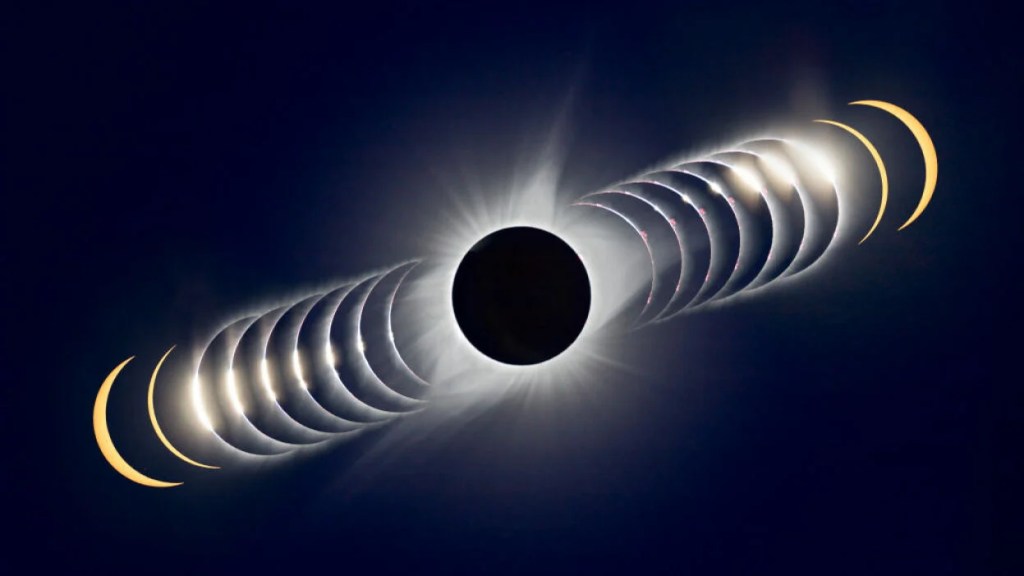
Do you remember the 2017 and 2024 eclipses? They may have seemed like magical events, but do you know the scientific explanation behind these natural wonders? Here, we will explore and explain the fascinating physics behind solar eclipses.
To understand the mysteries of solar eclipses, scientists have turned to math and physics. Through calculations and observations, they’ve uncovered the intricate explanation behind these occurrences.
A solar eclipse occurs when the Moon aligns with the Sun, casting a shadow on Earth. The Sun is about 400 times farther from the Earth than the Moon and almost 400 times larger than the Moon. However, when viewed from the Earth’s surface, the Sun and Moon seem to be of similar size. This illusion allows the Moon to perfectly block out the Sun during a total eclipse.
In order to understand the physics behind a solar eclipse, scientists need to visualize the moon’s trajectory. Total eclipses only occur when the Moon completely blocks the Sun’s light, creating darkness in the umbra. Surrounding the umbra is the penumbra, a shadow where only a portion of the sun is obscured. More commonly known as partial eclipses, the happenings result from the Moon partially obscuring the Sun, causing varying light levels based on one’s perspective and positioning in relation to the occurrence.

Positions of the Sun and Moon during an annular eclipse.
It is key for physicists studying an eclipse to know the key mathematical and physical principles that govern our universe. Kepler’s Laws of Planetary Motion describe how planets move in elliptical orbits around the Sun, how a planet covers the same area of space in the same amount of time no matter where its location is in the orbit path, and that a planet’s orbital period is proportional to the size of its orbit.

Kepler’s Laws of Planetary Motion
Newton’s Law of Universal Gravitation states that every particle attracts every other particle in the universe with a force that is directly proportional to the product of their masses and inversely proportional to the square of the distance between them.

Newton’s Law of Universal Gravitation
These laws are used to predict the precise timing and orbital path of solar eclipse occurrences. Calculations involve factors such as the orbital periods and distances of the Earth, Moon, and Sun, as well as the geometry applied when looking at the alignment during an eclipse. By applying these mathematical modes, scientists are able to accurately predict these events, making them more enjoyable for the public who can expect them.
Websites like NASA’s science.nasa.gov and space.com offer more insightful resources for those who wish to explore the math and physics behind solar eclipses in more depth.
Sources:
A solar eclipse sheds light on physics
https://phys.org/news/2015-05-solar-eclipse-physics.html
The science behind a solar eclipse
https://www.timesargus.com/features/weekend_magazine/the-science-behind-a-solar-eclipse/article_b73cbd5d-b4c7-552f-b7d5-c034d46ac9de.html
What is an Eclipse?
https://www.usi.edu/solarpalooza/educational-resources/science-of-the-eclipses#:~:text=For%20a%20solar%20eclipse%2C%20the,Diagram%20of%20a%20Solar%20Eclipse.
Why Do Eclipses Happen?
https://science.nasa.gov/eclipses/geometry/
Space.com
https://www.space.com/
Total Solar Eclipse: The Physics of Light
https://blogs.nasa.gov/Watch_the_Skies/2017/07/14/total-solar-eclipse-the-physics-of-light/
The Amazing Mechanics of How and When Solar Eclipses Occur
https://www.space.com/37801-the-math-and-physics-of-solar-eclipses.html
Solar Eclipses
https://scied.ucar.edu/learning-zone/sun-space-weather/solar-eclipses
NASA Science
https://science.nasa.gov/
 Science News
Leave a comment