Article originally written by Aarush Dey ’27.
Solar eclipses are rare celestial events that occur when the Moon passes between the Earth and the Sun, casting its shadow on Earth. This alignment creates a remarkable visual spectacle, but understanding the science behind it is essential for safe observation.
How Do Solar Eclipses Occur?
Solar eclipses occur during a specific alignment of the Sun, Moon, and Earth. Though these bodies vary vastly in size, for a brief moment, the Moon perfectly or slightly blocks the Sun in a way that makes it visible from certain regions of Earth.
What Are Some Types of Solar Eclipses?
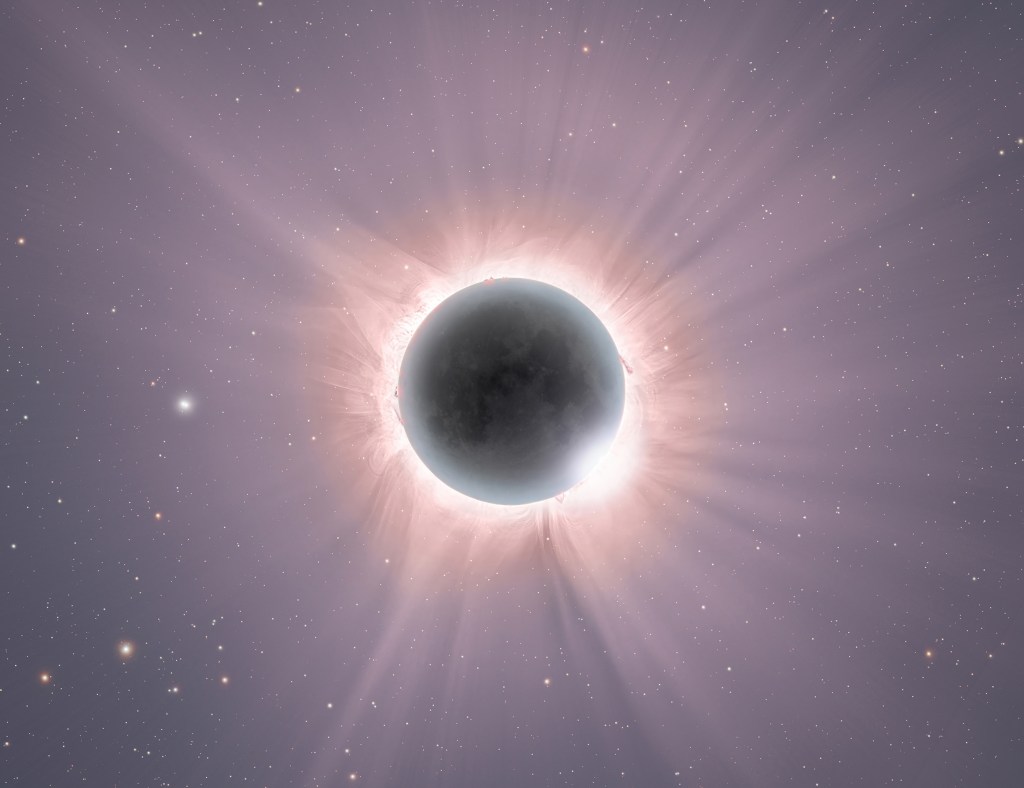
A total solar eclipse occurs when the Moon completely covers the Sun, momentarily casting a shadow on Earth and revealing the Sun’s corona. A partial solar eclipse occurs when only a portion of the Sun is obscured by the Moon, resulting in a partial shadow cast on Earth. An annular solar eclipse occurs when the Moon is at a further point in its orbit and appears smaller in the sky, resulting in a ring-like appearance around the Sun. A syzygy is a word to describe solar eclipses that occur during a rare alignment of the Sun, Moon, and Earth along a straight line.
How Should I Safely Watch This Exciting Eclipse?
Observing a solar eclipse without proper eye protection can cause permanent eye damage or blindness. It’s crucial to follow certain safety measures in order to keep your eyes out of harm’s way. The first of which, and possibly the most important, is wearing certified protective eyewear. These simple glasses are equipped with solar filters that block harmful UV rays, infrared radiation, and intense visible light emitted by the Sun. Another way to safely view this miracle is by creating a pinhole projector using cardboard or a similar material. By poking a small hole in the cardboard and projecting the image of the Sun onto a flat surface, such as the ground you will be able to see the Moon slowly cover the Sun until it is fully obscured, depending on your location. After preparing all of this safety gear, you want to make sure that you will actually be able to see this astronomical sight! To prepare, monitor weather forecasts and eclipse timings to ensure clear skies and optimal viewing conditions so be prepared to travel to locations within the path of totality.
Solar eclipses provide a unique chance to observe a captivating show of celestial objects. Grasping the science behind it and taking safety precautions provide the best experience for you and anyone else interested in this rare occasion. Make sure to fully appreciate the beauty and importance of these stellar events.
Sources:
Cover Image: Totality by Andrew James McCarthy (Cosmic Background)
https://cosmicbackground.io/pages/total-eclipse
 Science News
Leave a comment