Article originally written by Daphne Panie ’27.
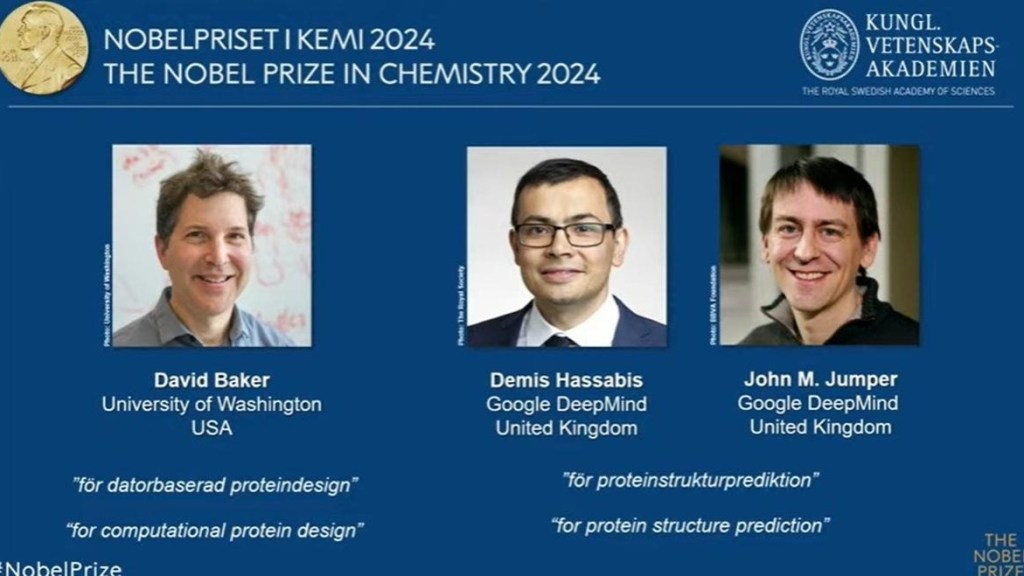
The 2024 Nobel Prize in Chemistry was awarded to three scientists, David Baker, Demis Hassabis, and John M. Jumper, for their major contributions to predicting and designing the structure of proteins. Encoded by DNA and RNA, proteins are crucial to human survival as they make up the building blocks of life. They drive the behavior of all living things, from viruses to humans. Proteins are single-string compounds that acquire a specific structure that defines their function, meaning that the key to understanding proteins’ function is to discover how they wrap themselves. One of the major challenges in this field was designing the precise shape of the different proteins, which was called “the protein folding problem”. One person on the Nobel Prize committee for chemistry showcased the importance of this discovery in chemistry as he declared: “In order to understand how proteins work, you need to know what they look like, and that’s what this year’s laureates have done.”
Half of the Nobel Prize went to David Baker, while the other half went to Demis Hassabis and John M. Jumper. David Baker, from the University of Washington, used computational protein design to invent new proteins, while Demis Hassabis and John M. Jumper both from Google Deepmind, used an AI to predict protein structure.
Demis Habissis and Joh Jumper, the youngest chemistry Nobel prize winner for 70 years, both work at Deepmind, which was founded by DemisHabissis, along with one of his childhood friends, in 2010. They started exploring technologies, such as AlphaFond, that could solve some scientific problems. They later created an AI that can predict the shape of the 200 million + proteins in the human body that scientists have identified. AI-powered drug discovery and development is a growing area of science and will make maany breathtaking discoveries in the future. The chair of the Nobel Committee for Chemistry declared: “Four years ago in 2020, Demis Hassabis and John Jumper managed to crack the code. With skillful use of artificial intelligence, they made it possible to predict the complex structure of essentially any known protein in nature,”
David Barker designed his first new protein in 2003 and he and his research team have not stopped creating protein since that time. He also designed proteins that could be used as medication or sensors. He also developed a computational program enabling scientists to design their own protein with different shapes and functions which will allow for many breakthroughs in the field of medicine. Barker’s Institute for Protein Design hosts multiple startups in these fields such as Vilya, whose goal is to create therapeutic molecules, or MonodBio which is a diagnostic biosensor company.
The Chair of the Nobel Price of Chemistry declared that the Nobel Price of Chemistry was actually really a “breakthrough in biochemistry”. In the future, as technology advances and scientists have more advanced tools, major breakthroughs will be accomplished, especially in the fields of biology and chemistry.
Sources:
Nobel Prize in Chemistry Goes to 3 Scientists for Predicting and Creating Proteins
https://www.nytimes.com/2024/10/09/science/nobel-prize-chemistry.html
Nobel Prize in chemistry awarded to scientists for work on proteins
https://www.npr.org/2024/10/09/g-s1-27123/nobel-prize-in-chemistry-awarded-to-david-baker-demis-hassabis-and-john-jumper
AI Wins Nobel Prize… Again! (Cover Image)
https://sbmi.uth.edu/blog/2024/ai-wins-nobel-prize-again.htm
 Science News
Leave a comment