Article originally written by Aarush Dey ’27.
What are they?
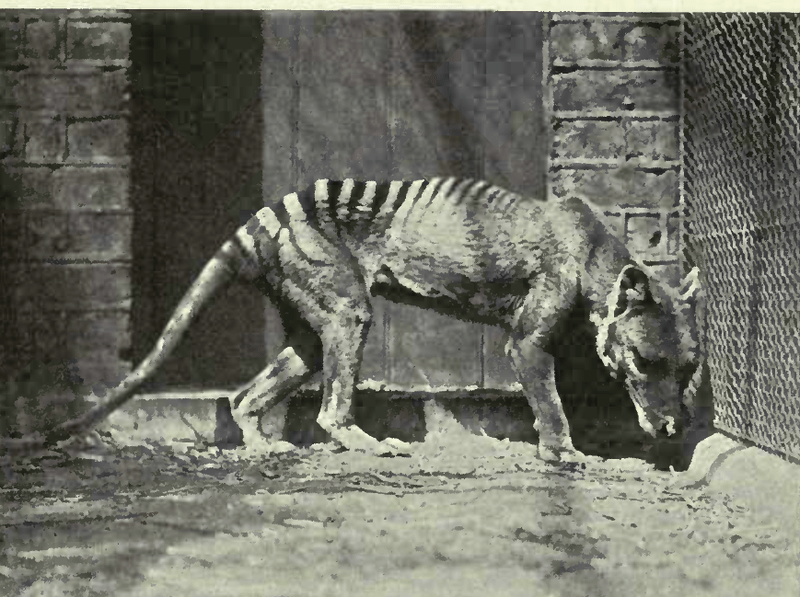
The Tasmanian tiger, or thylacine, was a marsupial with many canine-like characteristics. Despite its name, it wasn’t actually a tiger but got the nickname from the stripes on its back. Thylacines were carnivores that went extinct due to overhunting, habitat loss, and competition with other animals, fully going extinct in 1936. They have since become a symbol of the importance of protecting endangered species to prevent future extinctions but now scientists are doing everything they can to “reverse time” and bring back this elegant creature.
How is this possible?
The concept of bringing back Tasmanian tigers, or in other words, “de-extincting” them has recently gained a surge of attention. Researchers at Colossal Biosciences and the University of Melbourne have announced breakthroughs last month that have advanced us a couple steps forward to resurrecting this long-extinct carnivorous marsupial. Colossal Biosciences is a company known for its genomic resurrection efforts involving the Dodo Bird, Wooly Mammoth, and Tasmanian tiger. Recently, they were able to “assemble the most complete Tasmanian tiger genome to date”, according to an article from USA Today. Colossal Biosciences gained attention in 2021 by boldly announcing its intention to use gene editing techniques to bring back the wooly mammoth. The research aimed to modify elephant DNA to incorporate traits characteristic of mammoths, such as thick fur and a layer of fat, to enhance the survival of these hybrid animals in the Siberian tundra. This general methodology is now being reapplied to the Tasmanian tiger. A preserved, century-old Tasmanian tiger head has enabled scientists to extract fragile RNA molecules from the sample, allowing them to observe which of the thylacine’s genes were active in specific tissues. “With this new resource, we can determine what a thylacine could taste, smell, see, and even understand aspects of its brain function,” said Professor Andrew Pask from the University of Melbourne. Though not fully completed, the scientists are confident in their ability to fill in the missing gaps of the genome, buttressing de-extinction efforts. Successfully piecing together the full genome would be an immense leap forward, significantly increasing the likelihood of the Tasmanian tigers’ resurrection.

What are the drawbacks and moral conflicts?
It is without doubt that implementing such a new technological concept would come with its own valid critiques and questions. Many argue that bringing back an animal that went extinct almost a century ago would simply be cruel. In many ways this is true; the climate and ecosystems 100 years ago are drastically different from the ones today. This is not a negative consequence but simply a fact, and bringing a species into a habitat it was never meant to live in could have quaking impacts on wildlife in that area. Others believe that de-extinction is simply too difficult and is instead just feeding misinformation online. Professor Jeremy Austin from the Australian Centre for Ancient DNA told the Sydney Morning Herald in 2022 that “De-extinction is a fairy tale science,” when Colossal’s project was brought to the public view.
Key Takeaways
Though a controversial topic, the de-extinction efforts surrounding Tasmanian Tigers are a scientific marvel nonetheless. It would be a significant scientific achievement, proving that modern technology could potentially reverse some human-caused extinctions. This “de-extinction” effort also serves as a reminder of the importance of protecting endangered species today, encouraging stronger conservation efforts to prevent future extinctions.
Sources:
Tasmanian tiger moves closer to de-extinction as scientists assemble near-complete genome
https://www.usatoday.com/story/news/nation/2024/10/21/extinct-tasmanian-tiger-closer-to-revival-after-breakthroughs/75775350007/
Scientists claim breakthrough to bringing back Tasmanian tiger from extinction
https://news.sky.com/story/scientists-claim-breakthrough-to-bringing-back-tasmanian-tiger-from-extinction-13234815
Scientists Have Worked Out The Probability That Tasmanian Tigers Still Exist (Cover Image)
https://www.iflscience.com/scientists-have-worked-out-the-probability-that-tasmanian-tigers-still-exist-41327
Colossal Laboratories and Biosciences (Image 2)
https://colossal.com/species/
 Science News
Leave a comment