Article originally written by Tia Agarwal ’26
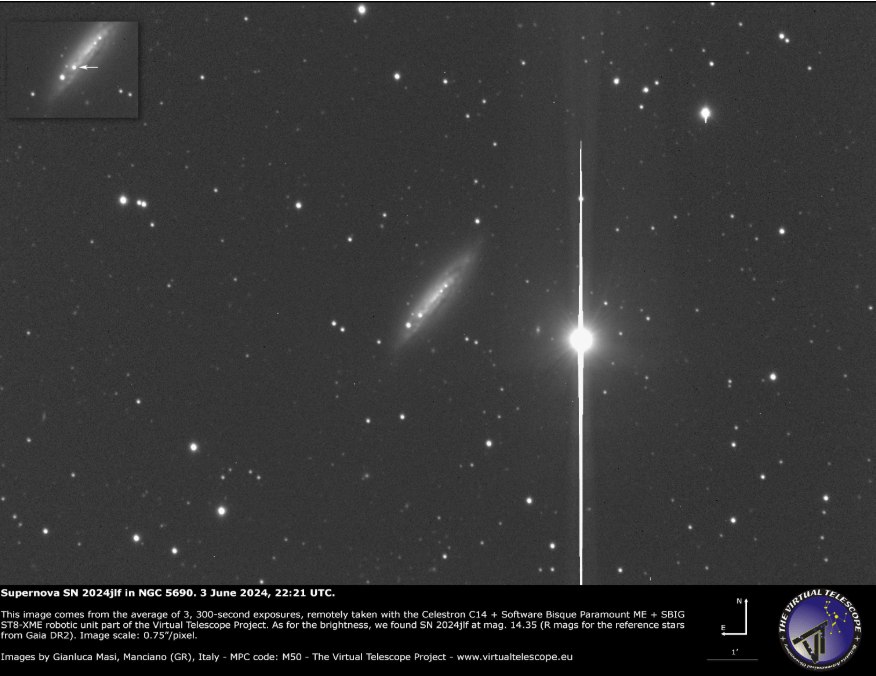
SN 2024jlf might sound like a misspelled word or extra letters tacked onto a label, but it is, in fact, an identifier for a newly detected Type II supernova. A supernova is a bright, luminous explosion of a star, occurring during the star’s last evolutionary stage. Supernovas happen because of the collapse of massive stars, and they are the biggest explosion humankind has ever seen. Even though astronomers classify them as transient [meaning they last for a short time], one can’t underestimate their impact. These explosions are usually the birthplace of black holes, and the gamma and cosmic rays released by them can eradicate our ozone for decades, even if they are 50 million light years away.
Astronomers classify supernovas in three categories: Type I, Type II, and Type III. Type I and Type II differ on whether or not a star shows hydrogen in its spectrum, and Type III refers to a ‘electron capture’ nova which borders between becoming a white dwarf and undergoing neutron collapse and becoming a black hole. SN 2024jlf is classified as a Type II supernova; these result from stars at least eight times as massive as the sun.
On May 28, 2024, SN 2024jlf was seen at the Zwicky Transient Facility (ZTF) based out of San Diego, California. It had a brightness of 15.88 mag [on the apparent magnitude scale, a lower value refers to a brighter object], meaning it was quite faintly seen when it was discovered [for reference, the sun is -21 mag bright]. The location of the supernova is estimated to be galaxy NGC 5690, around 95 million light years away. A research team led by Nabeel Rehemtulla of Northwestern University estimated the mass of the progenitor [the star undergoing collapse] of the supernova around 10 solar masses. Its collapse released 1.5 sexdecillion (1.5 x x 1051) erg of energy: for reference an atom bomb releases 1 x 10²⁰ erg of energy, and a regular supernova releases 1 x 1051 erg. 1.5 sexdecillion erg is more energy than the sun will ever produce in its lifetime. After its initial sighting, the team reported that the supernova grew by 4.0 mag every day, quicker than 90% of the other Type II supernovae in the ZTF sample.
The researchers conclude that the supernova is a ‘young supernova’, it shows a blue continuum [meaning its emissions are skewed towards blue wavelengths, therefore presenting a predominantly blue light] with weak flash features [the flash spectrum tracks light coming from the lowermost layers of the solar atmosphere]. A supernova is recent if it allows astronomers time to understand the effects the collapse has with its surroundings.
SN 2024jlf isn’t the only supernova found by astronomers in 2024, and the search for supernovas continues in facilities like the ZTF all around the planet. Learning about supernovas gives astronomers an insight into how galaxies are made, black hole formation, cosmic rays and more. Plus it’s super cool to look at the telescope pictures!
Sources:
https://www.virtualtelescope.eu/2024/06/06/supernova-sn-2024jlf-in-the-ngc-5690-galaxy-an-image-3-june-2024/ (Cover Image)
https://phys.org/news/2025-02-astronomers-evolution-newly-supernova.html
 Science News
Leave a comment