Article originally written by Aarush Dey ’27.
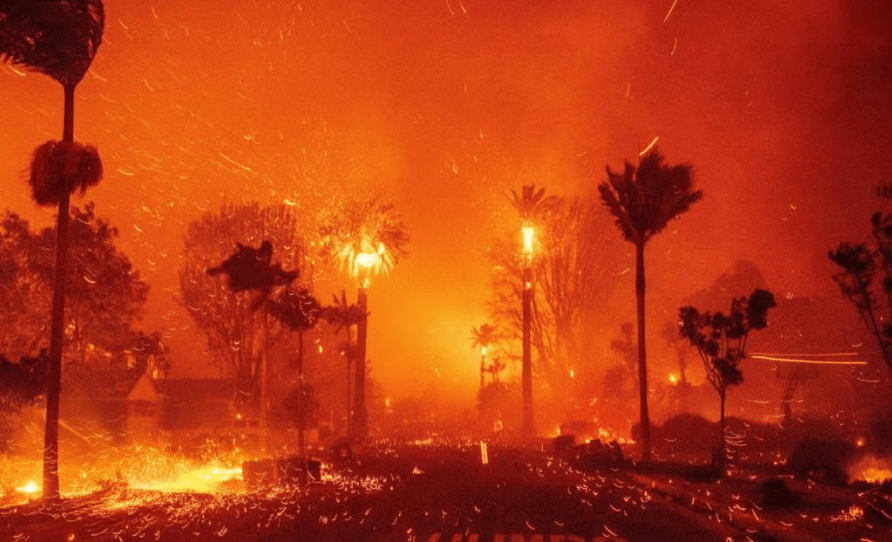
The recent firestorms that engulfed Los Angeles County have once again highlighted the growing danger of climate change. While the city is still struggling to recover from disastrous fires that raged across urban and wildland areas, scientists and specialists are sounding warnings about how climate change is accelerating fire dangers in California.
This year’s fires have been historically intense, fueled by record temperatures, prolonged drought, and fierce Santa Ana winds, all fueled by the warming planet which brings along with it severe weather events. Firefighters have battled fires that have scorched thousands of acres of land, destroyed homes, and claimed many lives. The smoke has shrouded Los Angeles, creating hazardous air quality that affects millions of residents.
The cause of these increasingly devastating fires is the changing climate. “The hotter and drier conditions created by climate change create the perfect environment for wildfires”, says Dr. Samantha Clark, a climate scientist at the University of California. “Longer periods of drought mean vegetation becomes dry and more susceptible to ignition, while higher temperatures exacerbate fire intensity.”
Over the past 30 years, total annual acres burned have skyrocketed. In 1990, California was estimated to have burned some 600,000 acres, as estimated by the National Interagency Fire Center. in 2020, the number climbed to over 4 million in one year alone. Fire season lasts several months now, beginning in the spring and going well into winter. Specialists predict this trend of rising acreage burned and season length to continue, with California facing increasingly uncertain wildfire prospects.
The Science Behind the Flames: A Changing Climate
The causes and correlations between the wildfires and climate change are complex. The most critical factor is the increase in temperature, which resulted in higher evaporation rates, leaving the lots of ground dry for extended periods of time. This dryness creates ideal conditions for wildfires, as tinder-dry underbrush and dry grasslands become more susceptible to ignition.
Moreover, partially due to this temperature decrease, droughts are becoming more severe and frequent. Research indicates that global warming has intensified and increased the frequency of droughts in the western United States. Once the ground reaches a certain dryness, even minor sparks, which can sprout from a multitude of factors, could result in a wildfire.
Additionally, the Santa Ana winds that regularly sweep through Southern California have intensified in recent years as weather conditions become even more extreme due to climate change. Therefore, once the fires start, even if they are miniscule, they can easily spread with the winds, posing a massive threat to nearby communities. The combination of rising temperatures, dry fuels, and strong winds creates a dangerous scenario for Californians.
A Worsening Emergency: The Devastation for Communities
Even though firefighters and emergency responders act as best as they can to protect lives and homes, the destructive power of these fires still takes a staggering toll on local communities. Thousands are left homeless, and countless homes are reduced to rubble. The financial impact is astounding, affecting property, infrastructure, and the costs associated with firefighting.
Though the actual fire is obviously the primary threat, the smoke from these fires is equally dangerous. Heavy black smoke has resulted in an increase in respiratory illnesses, hospitalizations, and risks for vulnerable populations, including children, the elderly, and those with pre-existing health conditions.
Mitigation and Long-Term Solutions
As fires rage on, both Californian and the federal government have been at work brainstorming solutions and policies to mitigate these fires in the future. Local government and fire department officials are increasing efforts to get communities fire-ready and fire-responsive. These include everything from adding rules and restrictions to the burning of crops, building firebreaks, to stricter building codes to construct fire-resistant homes.
Defensive areas in residential areas are one of the main prevention strategies. Defensible space is defined as a location without dead plant life, trimmed trees, and houses made of fire-resistant materials. This solution should work, and would have a major impact on the destruction of wildfires.
Though these solutions seem promising, especially to the public eye, most experts concur that these measures are not sufficient. The real solution is to deal with the root cause of these fires: global warming. The long-term solution of California should involve extreme steps to reduce greenhouse gas emissions, transition to renewable energy, and investment in technologies to counter the effects of global warming.
“The most optimal solution to avoid the destruction wrought by wildfires is to avoid climate change in the first place,” states policy analyst John Martinez. “We need courageous action to reduce greenhouse gas emissions and move towards a sustainable future. Otherwise, the wildfires will only continue to spread in intensity, threatening not only our homes but the very ecosystems that provide California with its unique character.”.
As the state heals and rebuilds from the fires of this year, the call to climate action has never been more urgent. California cannot keep treating the terrible issues that stem from a larger problem. Climate scientists warn that unless immediate action is taken on climate change, the future of cities like Los Angeles—and surrounding natural landscapes—will remain threatened by the inescapable force of wildfire.
The destiny of California fire management needs to be multi-pronged, combining better techniques for preventing wildfires with stronger environmental policies for checking global warming. State and federal governments, and the global community, must join forces to address the climate crisis before wildfires become a more frequent and catastrophic norm in California.
Sources
- Scientific Research & Climate Studies
Intergovernmental Panel on Climate Change. (2021). Climate change 2021: The physical science basis. Cambridge University Press. https://www.ipcc.ch/report/ar6/wg1/
NASA Earth Observatory. (2020). How climate change is intensifying wildfires. NASA. https://earthobservatory.nasa.gov/features/Wildfires
NOAA National Centers for Environmental Information. (2022). Climate trends in the western U.S. NOAA. https://www.ncei.noaa.gov - Fire and Environmental Agencies
Cal Fire. (2021). Fire statistics and historical wildfires. California Department of Forestry and Fire Protection. https://www.fire.ca.gov/
National Interagency Fire Center. (2020). Wildland fire summary and statistics annual report. https://www.nifc.gov/fireInfo/fireInfo_statistics.html
U.S. Forest Service. (2019). The impact of climate change on wildfires in the United States. U.S. Department of Agriculture. https://www.fs.usda.gov/ - Government & Policy Reports
California Governor’s Office of Emergency Services. (2021). Wildfire preparedness and response. https://www.caloes.ca.gov/
Environmental Protection Agency. (2022). Climate change indicators: Wildfires. U.S. Environmental Protection Agency. https://www.epa.gov/climate-indicators/wildfires - News Outlets & Expert Testimonies
Los Angeles Times. (2023, September 15). California wildfires: What’s driving the increase in fire intensity? https://www.latimes.com/wildfires
National Public Radio. (2023, August 20). How climate change is fueling extreme wildfire seasons in California. NPR. https://www.npr.org/wildfires
The New York Times. (2023, July 10). Wildfires, air quality, and the fight against climate change. https://www.nytimes.com/wildfires - AI
Used ChatGPT to find sources and for basic understanding of concepts covered in article.

 Science News
Leave a comment