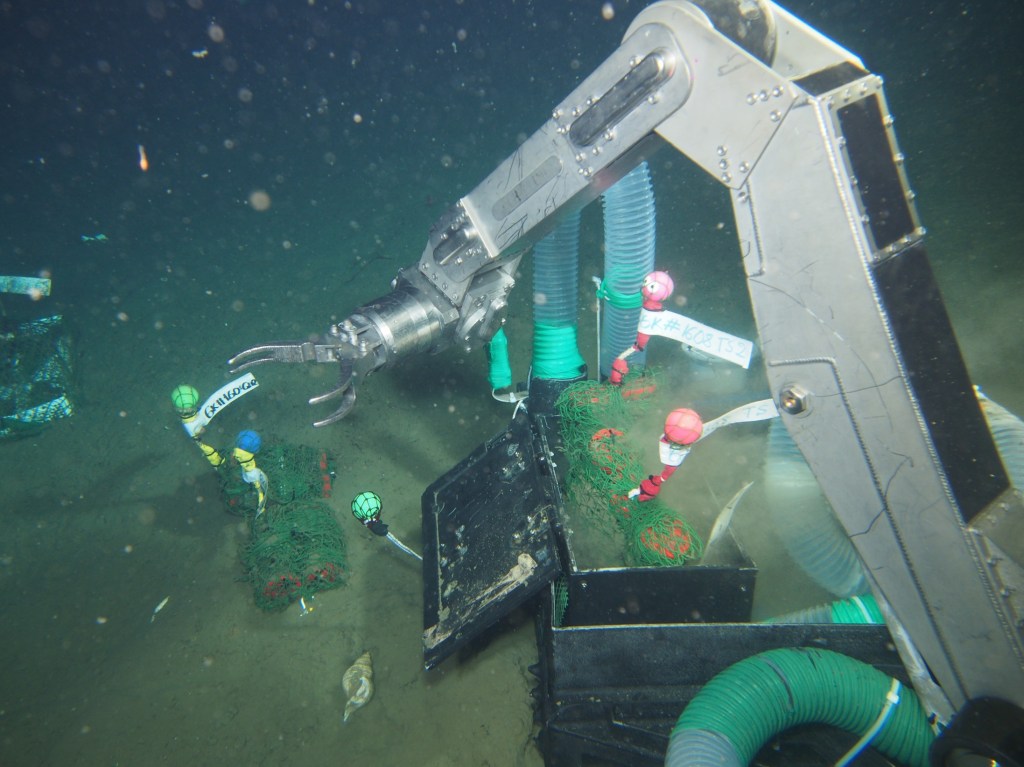
Article originally written by Emily Hau ’29.
An estimated 33 billion pounds of plastic enter the oceans every year. This is equivalent to dumping around 2,000 garbage trucks full of plastic every day. Deep sea conditions have high pressure, low temperature, and less nutrients, all of which can make plastic decomposition difficult. To combat this problem, Shinshu University in Matsumoto, Japan released a study this past summer about a new bioplastic. According to the university, researchers have found that poly (d-lactate-co-3-hydroxybutyrate) or LAHB can biodegrade in deep sea conditions.
In the study, researchers submerged a PLA film and two types of LAHB films near Hatsushima island where there is high salinity and low oxygen levels. These conditions make it difficult for microorganisms to degrade plastic. There was one LAHB film with 13% lactic acid and another one with 6% lactic acid. The results highlighted how the film with 13% lactic acid lost 30.9% of its mass over 7 months and over 82% of its mass after 13 months. The LAHB films were covered in biofilms which are communities of microorganisms that include algae, fungi, and bacteria. These deep-sea microbes were decomposing the plastic and colonizing. On the other hand, the PLA film had no loss in weight or any apparent degradation.
To gain this information, researchers examined the platisphere, which is the microbial ecosystem that covered the plastic. According to Phys.org, there are many different microorganisms that play a role in degrading plastic. One such organism is the Gammaproteobacterial genera: they produce enzymes that break down extended polymer chains into smaller fragments and eventually into their monomers. Working together with other microbials, these microorganisms convert plastic into water, carbon dioxide, and other harmless compounds.
The LAHB also creates a recycling loop, as the microorganisms break down the plastic into simple nontoxic compounds in the environment. It offers a solution to marine plastic pollution that is a growing pressing problem. According to Professor Taguchi at Shinshu University, this study “demonstrates for the first time that LAHB, a microbial lactate-based polyester, undergoes active biodegradation and complete mineralization even on the deep-sea floor, where conventional PLA remains completely non-degradable.”
In the future, researchers will try to optimize LAHB plastic while keeping its biodegradable properties. They will focus on increasing the commercial production of this plastic in the hopes of creating a more sustainable world.
Sources:
- (Cover Image) Shinshu University. (2025, July 17). The LAHB samples deployed in the deep-sea using Shinkai 6500 [Image]. Shinshu University. https://www.shinshu-u.ac.jp/english/topics/2025/07/labh-a-bioplastic-th.html
- Japan Agency for Marine-Earth Science and Technology (JAMSTEC). (2025, July 22). LAHB: A bioplastic that may solve marine plastic pollution problem. Phys.org. https://phys.org/news/2025-07-lahb-bioplastic-mass-months.html
- Davis, J. (2025, August 13). New biodegradable plastic breaks down in deep ocean where others can’t. Impactful Ninja. https://impactful.ninja/new-biodegradable-plastic-breaks-down-in-deep-ocean/
- Technology Networks. (2025, July 25). Biodegradable bioplastic designed to tackle deep-sea plastic pollution. Technology Networks. https://www.technologynetworks.com/applied-sciences/news/biodegradable-bioplastic-designed-to-tackle-deep-sea-plastic-pollution-402599
 Science News
Leave a comment