Article Originally Written by Joy Chen
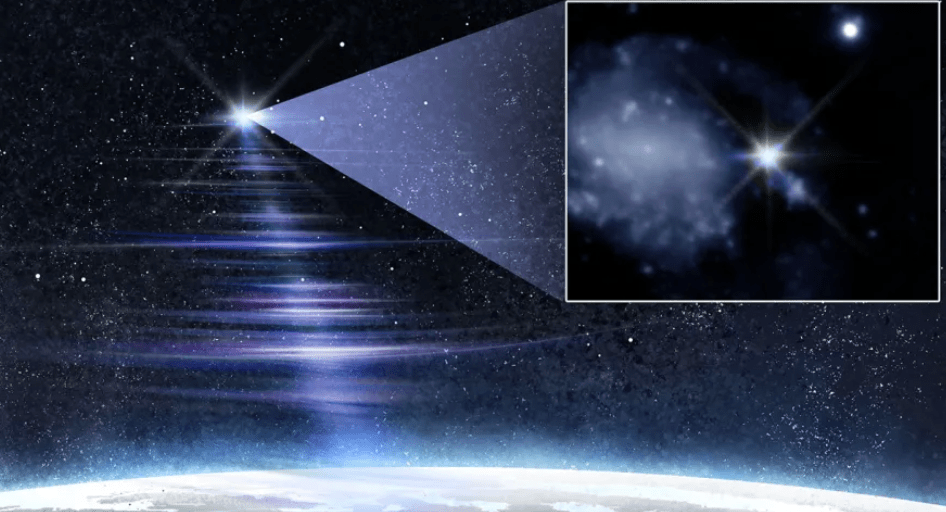
The strongest fast radio burst (FRB) ever observed has been discovered by astronomers. The energy unleashed by this millisecond-long burst of radio waves, which took an incredible 8 billion years to reach Earth, is equivalent to the amount released by our sun in 30-years. In June 2002, the Australian SKA Pathfinder (ASKAP) radio telescope discovered the event, which is now known as FRB 20220610A.
The significance of this detection is both in its dimension and in its distance. It is not only 4 times more energetic than any previously observed, but it also comes from a time when the universe was less than half its current age. That makes it the most distant FRB ever found. Follow up observations were also noted using the Very Large Telescope (VLT) in Chile. They found that the burst’s origin was from the merging of two or three galaxies.
Beyond producing record-breaking energy, this FRB also acted as a tool to confirm a crucial component of cosmology. Radio waves move through gas and plasma between galaxies as they traverse the cosmos. This leads to dispersion, a phenomenon where distinct wave frequencies arrive at different times. Astronomers were able to “weigh” the diffused, ionized material – otherwise very difficult to detect – by measuring the dispersion of FRB 20220610A. This supports existing hypotheses regarding the distribution of ordinary matter in the universe.
This single, fleeting burst of radio waves not only demonstrates the extreme processes at work in the universe, but also highlights the value of FRBs as unique probes for mapping the structure of the cosmos.
Sources:
information@eso.org. “Astronomers Detect Most Distant Fast Radio Burst to Date.” http://www.eso.org, www.eso.org/public/news/eso2317.
Gianopoulos, Andrea, and Nasa Hubble Mission Team. “Hubble Finds Weird Home of Farthest Fast Radio Burst.” NASA Science, 20 Mar. 2025, science.nasa.gov/missions/hubble/hubble-finds-weird-home-of-farthest-fast-radio-burst.Ryder, S. D., et al. “A Luminous Fast Radio Burst That Probes the Universe at Redshift 1.” Science, vol. 382, no. 6668, Oct. 2023, pp. 294–99. https://doi.org/10.1126/science.adf2678.
 Science News
Leave a comment